


AMD’s RDNA 4 lineup is… quite diverse, to say the least, and in a very confusing way. There’s way too much overlap, and the options on offer here seem confusing, at best. Cards like the RX 9050 and 9070 GRE, for example, are clear outliers that cater to niche use cases, making them hard to classify.
That is, until you start comparing them against a value-for-money proposition. AMD’s new lineup suddenly starts to make a whole lot more sense, especially against Team Green’s RTX 5000 Series. With that in mind, I took a deeper look at all of AMD’s RDNA 4 cards, weighing price and value over everything else.
Related
I picked AMD over Nvidia for my GPU and I regret it
Buyer’s remorse looks like screen tearing too.
RX 9050 ($279 MSRP)
A disaster of a card that has an (optional) 4GB of VRAM
Credit: Gigabyte
The RX 9050 is a profound disappointment. There has been a distinct lack of budget RDNA 4 options for a while now, and AMD chose to follow up with this. Not only does it offer quite terrible value, but it’s also offered in an insultingly low 4GB VRAM variant.
Sure, the 4GB RX 9050 is restricted to OEMs, but releasing a 4GB GPU in 2026 is definitely a choice. The card also connects to the PSU using a power cable, which makes it unusable for a good selection of systems, such as HTPCs.
The RX 9050 is currently not available in the US and is restricted to other markets by AMD.
You’re going to be much better off grabbing one of Intel’s Arc cards for HTPCs, which offer much better value (and more VRAM). They’re also very good for transcoding.
For gaming, something like a much older, used RX 6600 still remains your best bet. That card is going to be a lot more powerful, and won’t set you back by much. As it stands, the RX 9050 is the black sheep of the RDNA 4 family, and one that I wouldn’t recommend at all.
RX 9060 XT ($349 MSRP/$470 actual retail price)
Near-perfect budget and mid-range GPU
Credit: Sapphire
We now come to the RX 9060 XT, a GPU I consider to be one of the strongest of AMD’s recent RDNA 4 lineup, if not the best that they offer. The RX 9060 XT is a fantastic mid-range GPU, and offers plenty of performance headroom to move into 1440p and even higher territory.
It’s a perfect 1440p card, and can run just about anything you throw at it. It can even do 4K if you lower settings or take a trip back in time with older titles.
Like the rest of the RX 90xx lineup, the 9060 XT also supports FSR 4, which offers significant improvements in image quality over FSR 3.1. It also scales quite well.
Of course, there’s the elephant in the room that hasn’t been addressed yet — the presence of the 8GB version of the same card. The 16GB and 8GB versions are virtually identical otherwise, and there are zero reasons to recommend the 8GB model over its bigger brother.
Games have become more intensive than ever, and you’ll want at least 10+GB of VRAM for high-resolution gaming. 8GB is just not going to cut it, and will limit you to 1080p, which is a bit of a waste on this kind of GPU.
Overall, definitely a top-5 AMD GPU of all time contender.
RX 9070 GRE ($549 MSRP)
Strange times make for stranger cards
Credit: Gigabyte
The RX 9070 GRE is a bit of a strange card. It’s also not exactly new. In fact, it was released as a China-exclusive GPU first, before eventually making its way over to global markets.
The GRE (Golden Rabbit Edition) of the 9070 is sort of a successor to the 7900 GRE, although it does fall a bit flat on its face in terms of value. The card targets 1440p gaming, but is quite compromised.
The GPU holds only 12GB of VRAM, and has 48 CUs instead of the 56 you’d find in the RX 9070. It was meant to be positioned between the RX 9060 XT and RX 9070, but offered terrible value compared to either card.
At $549 MSRP (you’ll never find these cards at MSRP anyway), it made no sense. Most would go for the standard RX 9070, or a 16GB RX 9060 XT for cheaper. Times have changed, though, and the RX 9070 has had quite the price hike, while the 9070 GRE remains closer to its MSRP these days, likely due to its 12GB of VRAM.
This makes the RX 9070 GRE not as terrible a deal as it used to be. It’s surprisingly competent at 1440p gaming and is a solid alternative to Nvidia’s RTX 5070. 12GB of VRAM still hurts, though.
RX 9070 XT ($599 MSRP/$750 actual retail price)
AMD’s current “flagship” card is a true beast
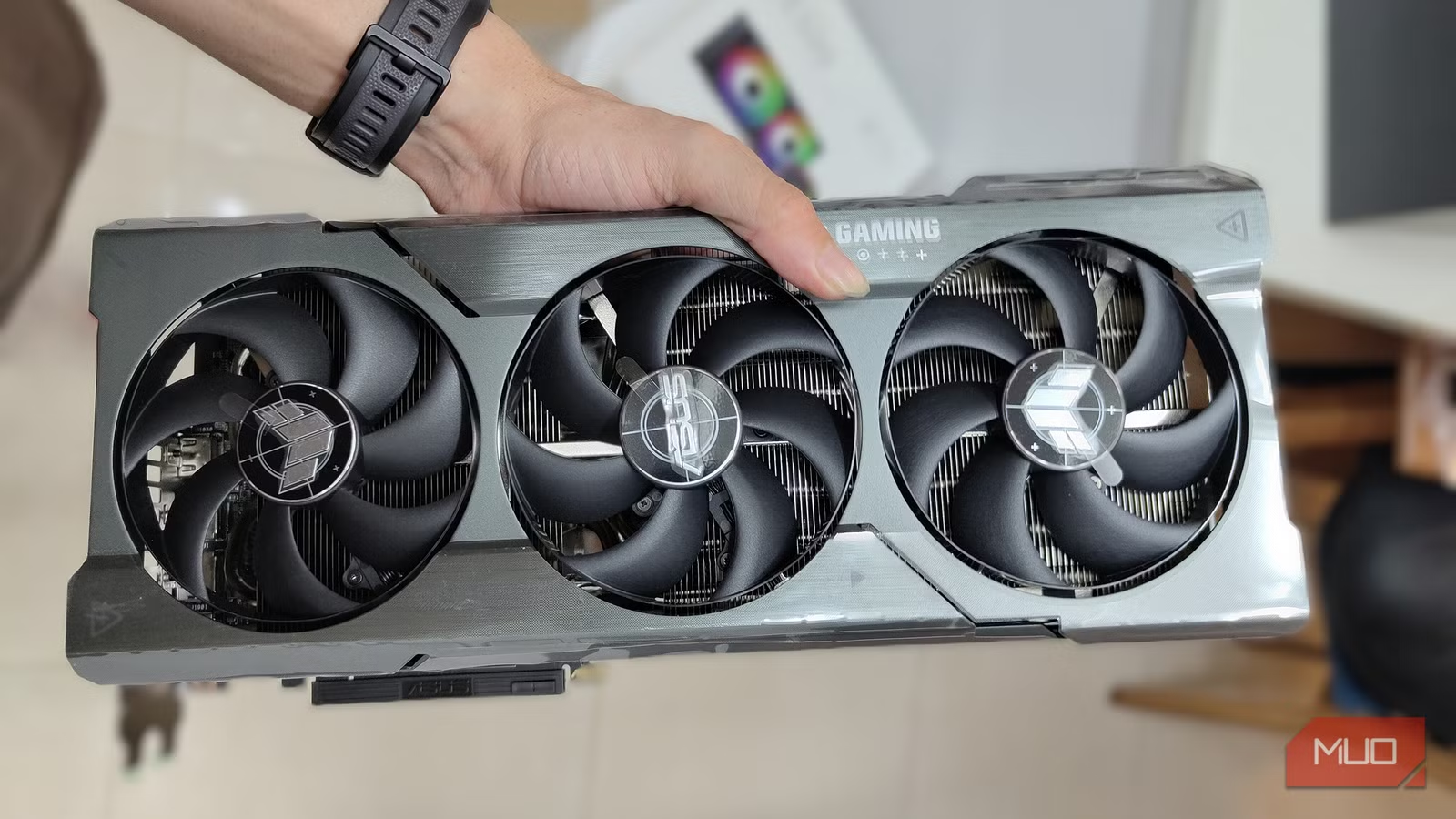
Credit: ASUS
This is the best AMD offers from its RDNA 4 lineup, but it’s technically more of an upper-midrange card (assuming you stick to MSRP). That said, this card offers some of the best performance and value AMD has delivered in a long, long time.
The RX 9070 XT is based on the Navi 48 XTX die and packs a whopping 64 CUs. It draws in a decent 304 W at maximum, and is targeted towards 4K and 1440p gaming.
It also directly competes with the RTX 4080 Super and offers what I consider much, much better value. The 9070 XT also offers superior ray tracing performance over the last gen, helping it gain a bit more performance. FSR 4 is also a very good upscaler and can trade blows with DLSS (even if DLSS still remains the superior choice).
Unless you plan on looking into the used GPU marketplace, the RX 9070 XT is one of the best cards you can get your hands on in 2026. Prices are finicky, though, and unsealed units fetch a lot more right now.
RX 9070 ($549 MSRP/$650 actual retail price)
Most of what the RX 9070 offers, at a lower price
The RX 9070 (non-XT) is essentially a (slightly) cut-down variant of the full RX 9070 XT. This non-XT version offers 56 CUs, 3584 stream processors, and a TGP of 220 Watts. This makes it a fair bit less powerful than the XT, but it is still quite good.
This is probably my favorite RDNA 4 card (minus the RX 9060 XT), and it offers good value and performance that is close enough to an RX 9070. I’ve been using it on my gaming PC, and it handles just about everything I throw at it, at an ultrawide (3440×1440) resolution.
Yes, you do need some FSR 4 from time to time, but for the price and performance on offer, some upscaling is justified.
Price per frame: Who wins?
In terms of price per frame, the winner is (to no one’s surprise) the RX 9060 XT, assuming you picked the 16GB version. It’s a fantastic GPU that shoots way above its weight class and is one of the best cards AMD has ever made.
On the opposite end of the spectrum, there’s the RX 9050. Even with the 8GB version, it offers quite poor value, and you’d honestly be better off trying to scrounge a used RX 6600 for that price.
The rest of the lineup is in a bit of a flux and offers good value, assuming you can get good deals on them. Overall, RDNA 4 is an excellent showcase from AMD and a return to form.