


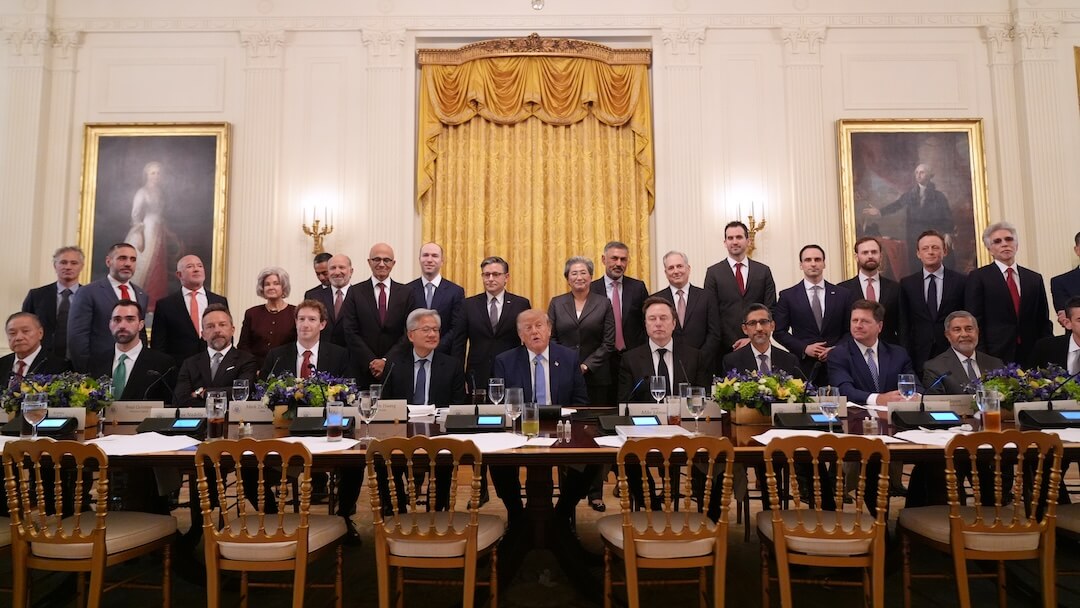
Seated in a row with the most influential leaders in artificial intelligence, President Donald Trump announced that he was renaming the technology itself.
“It’s not artificial. We all agree on that,” he said Sept. 29.
The same day, Trump released an executive order directing executive departments and agencies to use “super intelligence,” or SI, not AI, in their official communications. The order requires the use of the term “super intelligence” in place of the technologies and systems described in the existing AI definition under U.S. law.
There’s one issue: The AI industry already uses the term “superintelligence,” and it means something different than the government’s new definition. It’s a type of AI that doesn’t exist yet.
Superintelligence is AI that exceeds human cognition in nearly all fields, something the industry generally agrees no system has achieved. But that day no longer feels far off.
Executives at the country’s leading AI companies have called to slow down the development of AI because of its risks to humanity. Trump has rejected those calls, saying warnings of AI dominating humans are a “hoax.”
Trump has a history of co-opting words and changing their definitions to fit his narratives. He twisted the meaning of “fake news” from false online stories to a slur against legitimate journalism. He has also deemed global warming, investigations into his campaigns, and the Jeffrey Epstein files as “hoaxes.”
His preference for the term “super intelligence” aligns with his quest to remain ahead of China in the AI race. Alluding to people such as U.S. Sen. Bernie Sanders, I-Vt., who want to restrict AI development, Trump said Sept. 30: “If you stop work, somebody’s going to do it. And whoever wins super intelligence wins … And right now there are two players. It’s us and China.”
The AI leaders’ White House gathering also led to the signing of a voluntary framework for AI companies to self-regulate. There’s no federal law regulating AI, much less SI.
“It’s really important that we get our definition right with any attempts at regulating this very fast-moving technology,” said Baobao Zhang, a Syracuse University associate professor who studies the politics of AI. “The other concern is that you might have AI systems that currently do not fall under these definitions, that still could cause a lot of harm to humans, including catastrophic harm.”
‘Superintelligence’ dates back to the 1990s
Trump posted polls on Truth Social and X in September asking users to vote on an AI alternative, saying the name is “inaccurate and very ineloquent.” The options included “superior intelligence,” “extreme intelligence” and “supreme intelligence.”
This push isn’t new; Trump has been considering a name change for AI since at least July 2025.
“Around the globe, everyone is talking about artificial intelligence,” he said. “I find that too ’artificial’ — I can’t stand it. I don’t even like the name. You know, I don’t like anything that’s artificial. So could we straighten that out, please? We should change the name. I actually mean that. I don’t like the name artificial anything, because it’s not artificial. It’s genius. It’s pure genius.”
The term dates back to 1998, when philosopher Nick Bostrom gave a timeline for achieving “superhuman artificial intelligence.” He defined superintelligence as “an intellect that is much smarter than the best human brains in practically every field, including scientific creativity, general wisdom and social skills.”
Today, when people in the industry speak of AI that is more powerful than humans, they more commonly use the term “artificial general intelligence,” or AGI.
“There’s disagreement whether current AI systems have achieved that level of intelligence, and the terminology itself, I think, has been debated,” Zhang said.
Superintelligence goes beyond AGI.
Frontier companies have referred to superintelligence as pinnacle of AI
After Trump’s directive, there has been little to no change in how AI industry leaders refer to AI in public-facing material, though some have embraced the term “super intelligence” more than others.
Elon Musk, for example, said he will rename SpaceXAI, the AI company he founded, to SpaceXSI. At the White House Sept. 29, Nvidia CEO Jensen Huang called data centers “superintelligence factories.”
The AI systems that are familiar to most people fall under general-purpose AI, which can create text and images. ChatGPT is an example. But in spite of how precise general-purpose AI can be, the 2026 International AI Safety Report says it remains “jagged,” excelling at some tasks and failing at others.
Super intelligence would be a misleading descriptor for general-purpose AI, as well as AI systems that are more narrow in scope, such as self-driving cars or AI that diagnoses medical problems, Zhang said.
Companies have different internal definitions for their technology. In 2023, Google DeepMind authors sought to rank the levels of AGI. They classified ChatGPT, OpenAI’s flagship model, as Level 1, meaning “equal to or somewhat better than an unskilled human.” The levels above that — the highest of which was “artificial superintelligence,” for general AI that outperforms 100% of humans — were “not yet achieved.”
OpenAI published a 2023 blog post about governing the technology and calling for its safe development.
In 2025, superintelligence became the company’s goal. CEO Sam Altman wrote that AGI is achievable, and that “we are beginning to turn our aim beyond that, to superintelligence in the true sense of the word.”
Other AI companies shared the same vision. Meta CEO Mark Zuckerberg announced the launch of Meta Superintelligence Labs that year in pursuit of “personal superintelligence for everyone.” Microsoft AI said it formed a superintelligence team that was working toward “humanist superintelligence” — advanced AI that works “in service of people and humanity” and does not perform tasks with vast autonomy.
“We are in a new era,” Chris Lehane, OpenAI’s chief global affairs officer, said in an Oct. 2 CNN interview. Asked whether the technology has reached superintelligence, Lehane said it was “subjective.”
How leaders in Congress describe superintelligence
Some lawmakers have attempted to address the specter of superintelligence. U.S. Sens. Josh Hawley, R-Mo., and Richard Blumenthal, D-Conn., introduced a bill in 2025 that defined artificial superintelligence as AI that enables devices or software to “match or exceed human cognitive performance and capabilities across most domains or tasks,” and can operate autonomously and modify itself without human interference.
Sanders and Rep. Greg Casar, D-Texas, among others, have also introduced a bill seeking to pause the development of advanced AI, and ban AI superintelligence, defining it in similar terms as Hawley and Blumenthal.
U.S. voters appear to be on board. A September poll showed 68% support a bill that requires such a slowdown and ban.
“People are more fearful than excited about AI,” said Thomas Haigh, a University of Wisconsin-Milwaukee professor and historian of computing and information technology. “Rebranding it to superintelligence is unlikely to reassure them.”
PolitiFact staff writer Caleb McCullough contributed to this report.
This fact check was originally published by PolitiFact, which is part of the Poynter Institute. See the sources for this fact check here.