


How will you learn that the world is ending?
Maybe your phone buzzes with a news alert. Maybe you open Google News and see the headlines. But it’s also likely you sprint to social media and are met with a meme.
I told a friend something recently and didn’t realize until much later how bizarre it was: “Paul Revere in 2026 is an American Girl doll meme with neon Comic Sans telling you that your country is at war.”
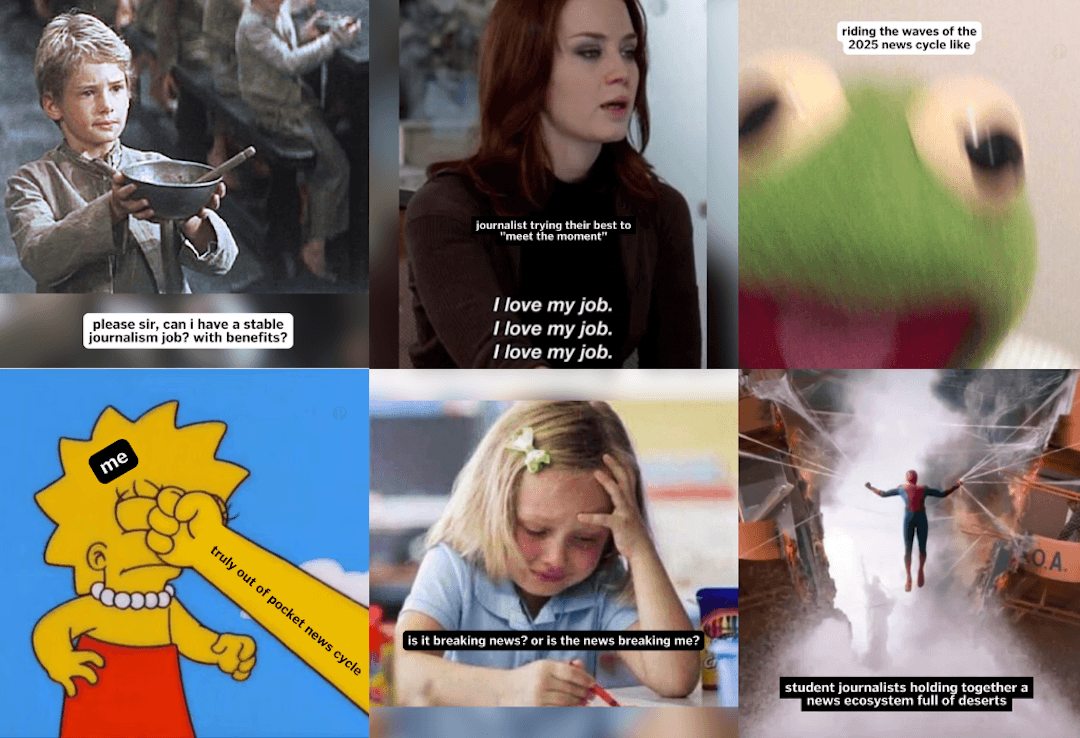
I make journalism memes as part of my role with Poynter, so this was a natural leap for my brain. Our Poynter memes pull the curtain back on what it’s like to be a journalist and find humor in many painful reporting experiences. I was still thinking about my “American Girl doll meme” comment weeks later. These days especially, something being “bizarre” doesn’t make it less true.
Humor has always had a place in American journalism, from comic strips and editorial cartoons to satirical outlets like The Onion and television pioneers like “The Daily Show.” Internationally, news satire and humor have thrived where traditional journalism was constrained or censored.
Across those mediums, memes included, humor serves similar purposes: critiquing power, spotlighting truth and connecting audiences with news and information they need and care about.
News memes seem to be the latest iteration of this tradition, a hybrid of the newspaper comic strip and breaking news alert: an unexpectedly pointed tool for disseminating information to our audiences.
Everyone is getting in on memes as communication tools, including corporate brands and the Trump administration. While some newsrooms have dabbled in memes, I think there’s room for journalists to experiment more with humor in their work.
In a (very serious) world where audiences are looking for relevance, reliability and relatability, humor can be a powerful tool for journalists to connect with new audiences in ways that traditional formats — and artificial intelligence — cannot. Our industry is being pushed into an era of content creation, viral video and AI. Maybe it’s time we try something new.
Humor’s ability to cut through the noise, tackle serious issues and engage audiences has never been more evident. Here are five reasons why humor may be worth experimenting with.
1. Humor has always had a role in U.S. news. Why not now?
The comic strip. Iconic editorial cartoons that rock the boat. Memes are part of a long evolution of using comedic images and illustrations, with or without text, as a way to communicate information and opinions to the masses. Humor remains a prominent part of today’s media landscape and it’s clearly having a moment. The Onion is in print and thriving. Jon Stewart is back on “The Daily Show.” Dave Jorgenson built a brand at The Washington Post by marrying humor and news in entertaining, digestible videos that resonate with younger generations — and later launched an independent venture called Local News International.
And by the way, news delivered with humor is more likely to be remembered and shared by younger audiences.
2. Social media algorithms aren’t on our side, but humor is.
Are we losing the social media war with Big Tech when it comes to getting our journalism in front of our audiences? I’m not sure. But I do know that social media platforms are deprioritizing news content for users and Google has tested removing its news tab. We can’t control how these platforms will change, but we can alter how we show up.
Understaffed newsrooms work overtime to publish stories. And for years, social media platforms have distanced themselves from news content and tanked the reach of articles in users’ feeds. But memes on social media? Those are forever, especially since memes are the language of the internet.
3. Humor can inform, entertain and push back
Humor has been used as a powerful communication tool across the globe. Effective satire can speak truth to power, furthering the mission of journalism in a democracy. Political satire, in particular, can provide a critical outlet for dissent under oppressive regimes. In Syria, protesters turned to humor to critique the Assad regime with online shows and songs. The “Egyptian Jon Stewart,” Bassem Youssef, parodied government officials both before and during the 2011 revolution. From Zambezi News in Zimbabwe to the satirical Venezuelan site El Chigüire Bipolar, humor has been a vehicle for protest, resistance and political critique in environments where free speech is restricted and traditional media are controlled.
4. Memes have “worked” for other public institutions. Why not us?
Remember that time the New York Public Library memed its way out of budget cuts?
I do. The relentless monthslong social media meme campaign illuminated the funding woes in the library system and motivated New Yorkers, library lovers across the internet and eventually public officials to do something.
The library’s social media manager, Victoria Reis, told LinkInBio’s Rachel Karten: “I think it worked so well because the meme is so unserious, in contrast to how serious the situation was.”
If the library can lean into memes at such a consequential moment, why not newsrooms, too?
5. It’s good for journalists’ mental health, too.
Journalists’ mental health is a serious matter. They face myriad work-related challenges, including anxiety, depression, secondary trauma and alcohol misuse. Journalists cover heavy subjects and are essentially first responders to human tragedy. Then there are the layoffs, newsroom politics, buyouts and other industry pressures. Plus, they are always in the eye of this nonstop news cycle. It’s all so heavy.
Poynter’s weekly journalism memes have become a ritual and a release valve for our audience of mostly reporters, editors, producers, photojournalists and educators. Memes have helped us build a hyper-engaged, eager and vocal community around our journalism. Our community of meme lovers is vast and diverse, and yet their reactions in the comments often echo one another: “THE ACCURACY” “I feel too seen” “too real.”
At a time when traditional media outlets struggle to connect with their audiences and are often seen as out of touch, humor offers a powerful tool for connection, especially on heavy political and societal issues.
We’ve made a lot of bets as an industry over the decades, but I believe humor is an experiment worth betting on.
Bonus: AI can’t be funny
Resources: