


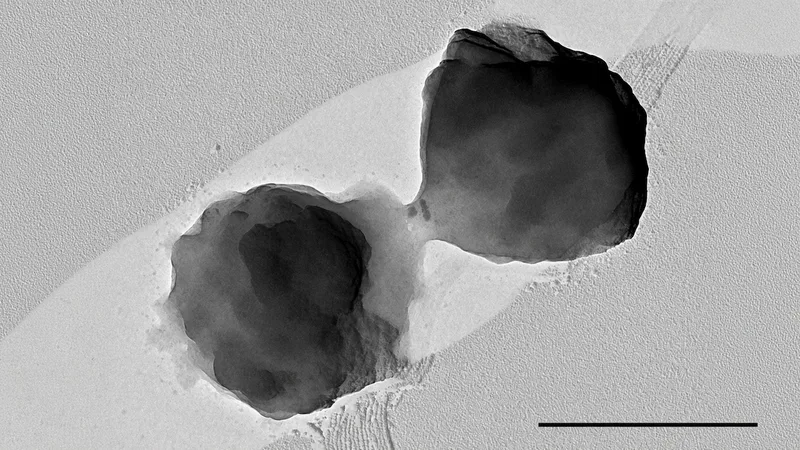
A methane-producing microorganism from Earth has grown in a laboratory replica of the seafloor of Saturn’s moon Enceladus, according to a University of Regensburg release published on Astrobiology.com. The work appeared in the journal Science Advances.
The team says the result does not show that life exists on the moon. It does show that one of Earth’s oldest metabolisms can function in conditions once judged deadly for this type of organism.
How the researchers built an Enceladus simulant
Enceladus is about 500 kilometres across. It has an ice shell over a global ocean and a solid core. Data from NASA’s Cassini mission showed that plumes from the moon carry molecular hydrogen, methane and dissolved minerals.
Astrobiology.com reports that this points to hydrothermal activity where the rocky core meets the water.
William Orsi, Professor of Geomicrobiology at Ludwig-Maximilians-Universität München (LMU), supervised the study. His team used an anoxic chamber. It holds oxygen at a tiny fraction of normal levels, here about 10,000 times lower than in Earth’s atmosphere.
Carbonate salts mimicked the moon’s alkaline, salty ocean and its rocky floor.
Scientists from LMU, the Woods Hole Oceanographic Institution, the University of Regensburg and Freie Universität Berlin took part.
What the microbe did
The researchers added Methanothermococcus okinawensis, an archaeon that normally lives near deep-sea hydrothermal vents on Earth. It runs on hydrogen and carbon dioxide. Its energy-making pathway is considered among the most ancestral still in use by life.
In a standard lab medium at a pH of 10 or 11, the organism did not grow. In the Enceladus simulant, it thrived. It kept growing and produced methane, using hydrogen generated by reactions between water and rock.
The Brighter Side (The Brighter Side of News) reported that growth continued at pH values as high as 11, beyond the microbe’s previously reported natural range.
The carbon problem
Carbon dioxide is scarce in the ocean because of its high pH. That shortage is a major obstacle for life on Enceladus. The team found that the microbe could scavenge the small amounts available and keep growing.
Orsi said the moon’s own chemistry appears to help overcome this barrier. He said the interaction of rock and water supplies hydrogen as an energy source. It also lets microbes keep reaching carbon despite the scarcity of carbon dioxide.
Vanessa Helmbrecht, the study’s lead author, said Enceladus is considered one of the most promising places to search for extraterrestrial life. She said the experiments suggest its geochemistry could be even more favourable to microbes than previously thought.
Sample-return plans
The researchers hope the findings will strengthen the case for missions that sample the ocean directly. The European Space Agency plans a mission to Enceladus. It is set to launch in 2042 and is intended to bring back samples from the ocean for study.
Orsi was careful here. He said the study does not prove life exists on Enceladus. He said it does show that key geochemical features of the moon’s environment can support life as we know it from Earth.