


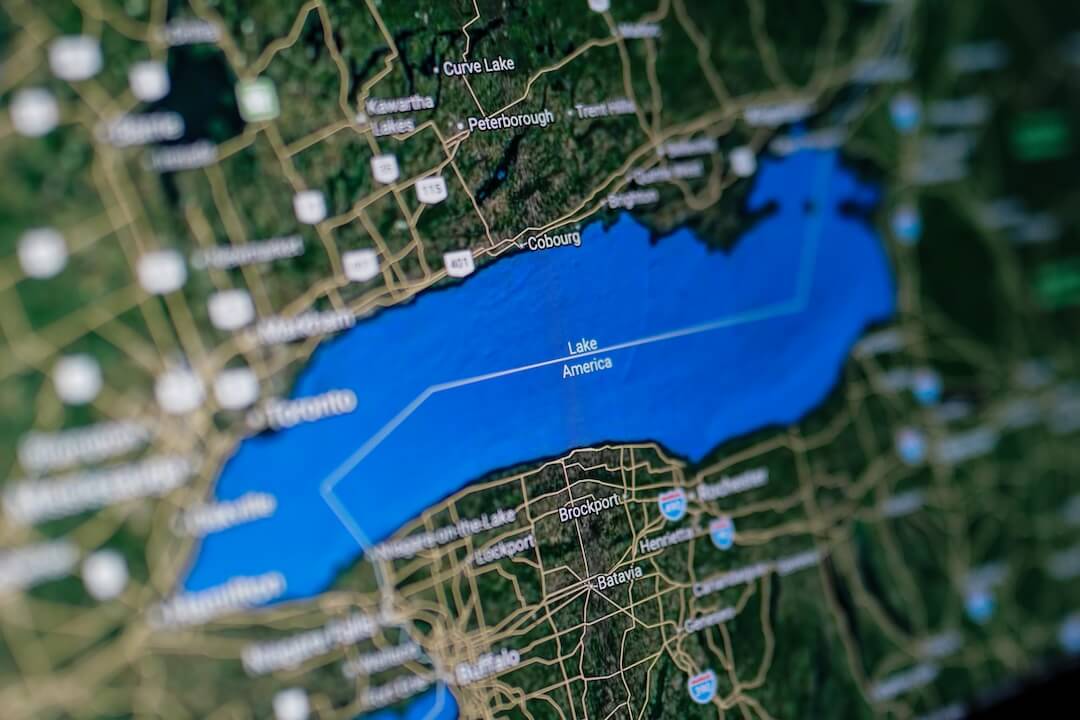
For the Associated Press stylebook, Gulf of Mexico stayed. Lake Ontario will, too.
In January 2025, Donald Trump, fresh into his second term, issued an executive order to rename the Gulf of Mexico as Gulf of America and restore the name Mount McKinley to Alaska’s Denali. On Aug. 27, embroiled in a trade war with Canada, Trump issued a new executive order to rename Lake Ontario as Lake America.
“If you think about it, we have a gulf and we have a lake,” Trump said when he signed the order. “Now, all we need is an ocean.”
In 2025, The Associated Press, which produces the stylebook that reaches 45.5 million users monthly in 100 countries, honored the directive on McKinley, which had been the mountain’s name from 1917 to 2015. The AP said the mountain was solely in the United States and that Trump, as president, had the authority to change federal geographical names within the country.
But the AP kept Gulf of Mexico, saying the name had stuck for four centuries and that, as a global news agency, it needed to keep place names and geography easily recognizable to all audiences.
On Tuesday, the AP again cited longevity when explaining why it will keep Lake Ontario. The new guidance, uploaded to the online stylebook, says, “Lake Ontario has carried that name for more than 400 years. Refer to it by its original name. If it is relevant to the story, acknowledge and explain the name Trump has chosen.”
In an accompanying explanation, the AP said Trump’s order affects only how the U.S. government refers to the body of water and that Canada and other nations and international bodies needn’t recognize the name change.
The AP also gave examples of geographical places with different names in different countries. For example, the U.S. government has designated the body of water separating Baja California and mainland Mexico as the Gulf of California; Mexico calls it the Sea of Cortez. The AP said it uses both terms depending on the context. Also, the water that international audiences and the AP call the Persian Gulf is, to many Arab countries, the Arabian Gulf.
Minding Trump’s latest order, Google adopted “Lake America” on maps for U.S. users, saying Aug. 29 that the switch aligned with U.S. Geographic Names Information System updates. (Google users beyond the U.S. will see both Ontario and America as the lake’s name.) Apple adopted “Lake America” on Sept. 1, after Trump, by Burgum’s accounting, made a personal plea.
MapQuest, though, kept “Lake Ontario,” and the app’s downloads surged. (MapQuest had kept “Gulf of Mexico” and had introduced a feature to let users name the gulf whatever they wanted.)
The Canadian government’s webpage on province and territory names says the earliest recorded use of “Ontario” was in 1641, used to describe a land mass on the northern shore of the easternmost Great Lake. The government said “Ontario” derives from the Iroquois word “kanadario,” which translates into “sparkling,” but the Prescott, Arizona-based Museum of Indigenous People reported that the name is also connected to the Huron-Wyandot word Ontarí:io (or Ontare), which translates as “great lake” or “beautiful lake.” (Canadian Prime Minister Mark Carney mentioned the Wendat origin on X.)
The Ontario name endures along the lake. Ontario Premier Doug Ford attended the unveiling of a giant billboard on the lake’s Canadian shore that reads “Lake Ontario — Now and Always.” In New York, the only U.S. state bordering the lake, Oswego County officials said they will keep “Lake Ontario” on official and business materials. On X, New York Gov. Kathy Hochul posted a map of the renamed lake and wrote, “New York won’t be calling it that.”
Trump’s order gave Interior Secretary Doug Burgum 30 days to install Lake America on federal maps, signs, communications and contracts, though state governments needn’t comply.
The situation is less clear for the International Joint Commission, a binational commission serving both the United States and Canada.
In an email, commission spokesperson Kevin Bunch didn’t answer the question directly. He wrote that the agency, established by the U.S.-Canada Boundary Waters Treaty of 1909, delivers science-based advice and supports coordination on transboundary water issues, but doesn’t comment on political matters or domestic policy issues of either nation.
Polls suggest Americans’ hot take is a thumbs down on the renaming. An Ipsos/Reuters poll of 1,023 U.S. adults, published Sept. 1, showed 63% of respondents opposed Lake Ontario’s renaming. Majorities of Democrats (84%) and independents (65%) opposed the name change and more Republicans opposed the order (43%) than supported it (33%). An Economist-YouGov survey of 1,592 U.S. adults published Aug. 31 found that 68% of respondents and 43% of 2024 Trump voters opposed the name change.
Whether this name sticks in American journalism is an open question. Nieman Lab’s Joshua Benton reported Sept. 3 that national outlets were using “Gulf of Mexico” 7.23 times as often as “Gulf of America,” compared with 1.24 times as often at the beginning of the period he studied.
The shift occurred across partisan audiences. News outlets favored by Democrats went from using “Gulf of Mexico” 2.51 times as often as “Gulf of America” to 26.89 times as often. Republican-favored outlets initially used “Gulf of America” 72% more often than “Gulf of Mexico.” By the end of the period, they were using “Gulf of Mexico” 3.13 times as often. That’s a 180 and then some.
The AP’s style entry is set, but whether past is prologue with Trump remains to be seen.
In February 2025, when the AP held firm on “Gulf of Mexico,” Trump’s administration barred its journalists from Air Force One and White House press events. The AP sued, arguing that excluding the AP for its editorial viewpoint violated the First Amendment.
In April 2025, a U.S. District Court judge ordered the White House to let AP journalists return to the Oval Office and other spaces and end a 44-day exile. However, the U.S. Court of Appeals for the District of Columbia Circuit stayed most of the ruling as the administration appealed. This left the White House greater discretion over the AP’s access to limited-space events.
The AP reported in November that its writers have had sporadic access to limited-space events at the White House since April, although its photographers have received much more frequent access.
Trump, who spent much of last week speaking at the Republican Party’s midterm convention in Dallas, has yet to respond to the AP’s Lake Ontario decision.