


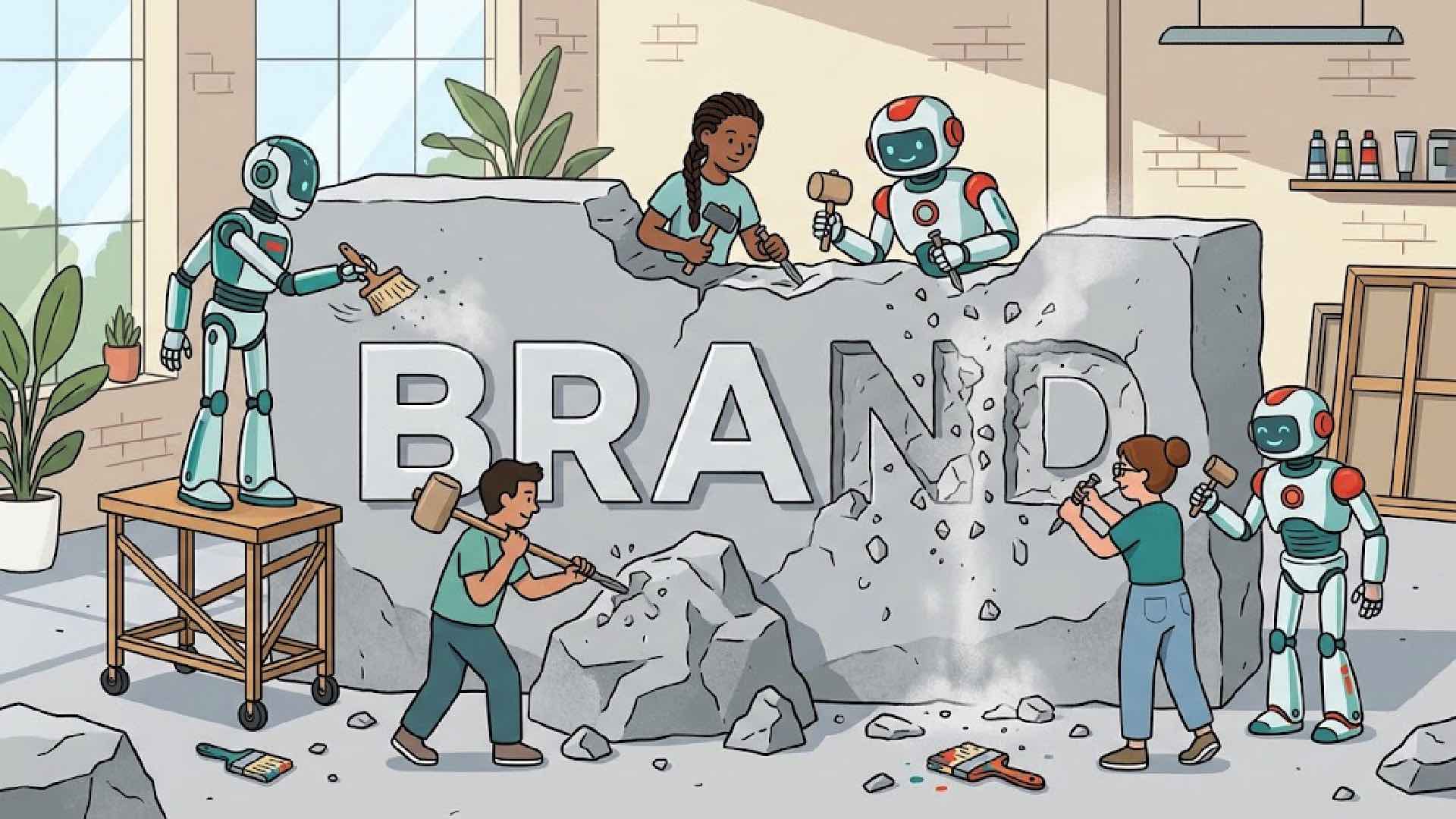
Your brand guidelines were built for humans. AI changes that.
Before AI, brand guidelines were built around adjectives describing feelings and qualities: “bold,” “premium,” “customer-first,” “family-friendly,” etc. This worked because they were interpreted by people who (usually) knew what they meant in relation to the brand.
However, it didn’t work perfectly. Give the same brand guide to 10 people and, by the tenth execution, “premium” will have 10 different meanings. That’s how you got brand drift.
Good organizations reduce the variation through training, culture, creative direction, reviews, and long-tenured people who know what the brand is supposed to feel like. Even then, brand drift was still in the mix. That’s because the guidelines were only part of the operating system. The rest lived in people.
Add AI, and you risk brand drift at scale. AI can act on adjectives, but not consistently. Marketers must move from implicit to explicit. They must define terms and lay out guidelines that specify which actions are consistent with the brand. Like whether or not to refund $800 after a technically valid denial.
Every brand framework contains an unstated assumption
In any brand strategy deck, a few words do a lot of work: approachable, premium, customer-first, innovative, bold but not arrogant. They didn’t need to be complete instructions because everyone knew someone would interpret them.
The framework could remain evocative because humans supplied what wasn’t written down. They absorbed culture through proximity. They recognized context. They remembered what happened last time. They understood when two principles collided, and somebody had to choose.
That invisible interpretive layer is why sophisticated branding has always depended so much on talented people.
10X your SEO with Semrush for Enterprise.
The world’s most powerful SEO platform, purpose-built for Enterprise.
Request demo
AI changes where brand strategy has to operate
Even with AI positioning, differentiation, audience, culture, or values remain the foundation of brand. What changed is the execution environment.
AI doesn’t spend five years sitting in leadership meetings. It doesn’t absorb the founder’s instincts by proximity. It doesn’t know that “transparent” feels reassuring in a product update but reckless during a security incident. It doesn’t know that the last three times the situation occurred, leadership made the same exception for reasons not in the brand guide.
AI can now propagate a single unresolved assumption across thousands of interactions at speed. A confused employee misreads one guideline for one customer on a Tuesday afternoon. A confused AI can misread the same guideline for 10,000 customers before lunch.
That new risk is also a new opportunity. The technology that forces us to confront ambiguity may give us the infrastructure to resolve it.
The goal is not to make AI interpret brand as humans always did, because humans have a gift for inconsistency. The opportunity is to extract the judgment that lived in the heads of a handful of people, make the important parts explicit, and build systems capable of carrying that judgment.
Sarah was the middleware
Your brand used to have an invisible interpreter. Let’s call her Sarah. Sarah reads a guideline that says empathetic but efficient, and just knows what that means for a furious customer versus a confused one.
She remembers that leadership said no the last time someone escalated a discount past a certain size, and she’s never forgotten it. Two people as competent as Sarah can read the same sentence in your brand guide and land in different places, and for 60 years, that wasn’t a crisis because a human was always going to smooth it over before the customer noticed.
AI now has to resolve this ambiguity with no Sarah to help it. The gap between the document and the decision, once filled by tenure and instinct, is now just a gap.
Get MarTech Insights That Matter
Platform news, strategy analysis, and industry trends. Trusted by 40,000+ marketing professionals.
Brand has moved from expression to behavior
For most of brand strategy’s history, the artifact was passive. A logo sits on a page. A tagline sits on a billboard. Even an expensive, beautifully designed website just waited to be clicked.
AI doesn’t wait. It recommends, adapts, escalates, personalizes, and commits. It takes an action before a human reviews it.
Brand has historically been most explicit where marketing has the most control, getting fuzzier as the customer moves into service, billing, renewal, disputes, and escalation. The brand is still present at those touchpoints. It’s just carried by culture, training, and the judgment of whoever happens to be handling the moment.
AI changes what is possible there. Brand judgment can now travel the entire decision chain rather than only the message that started it, making brand experience an operating dimension of the system rather than a layer applied at the customer-facing end.
Brand strategy now has to answer behavioral questions alongside the familiar expressive ones: What do we do, what do we refuse to do, and who decides what happens in a situation the guidelines never anticipated?
A brand only described in adjectives has no answer for a machine that has to act in the next 400 milliseconds.
The Canva principle, extended
Canva solved the easy 10% of this problem, the part that used to live in static branding guidelines, which nobody looked at after the launch deck. Load your logo, fonts, and color palette once, and everyone in the company can design something on-brand without review. Nobody got slower. The rails made everyone faster because the constraint enforced it instead of a person.
However, colors and fonts were never the hard part of consistency. The hard part is judgment, tone under pressure, and what to say when two good values collide. Reducing that to rails seemed impossible because judgment moves with context in ways that colors and fonts don’t have to.
That impossibility is now the problem brand teams have to solve. AI needs more than instructions for how the brand should look and sound. It needs enough of the company’s judgment to know how the brand should behave.