


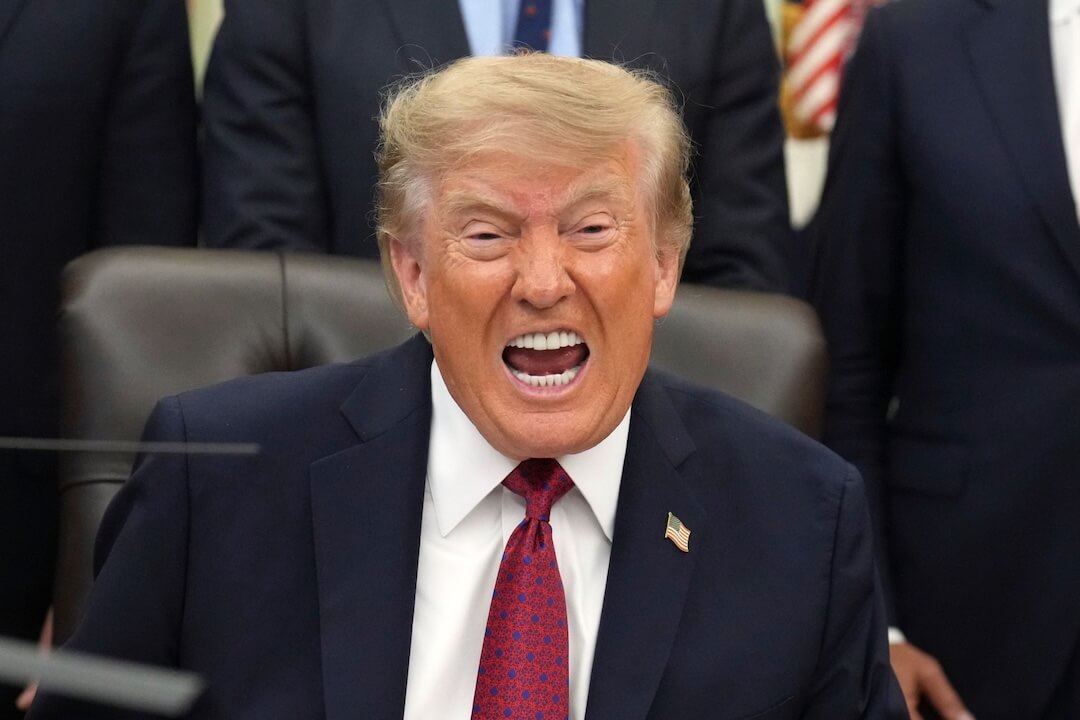
Those of us who write and talk about the media spent much of Monday discussing President Donald Trump’s weekend social media attack on NBC News’ Kristen Welker.
Speaking to the NBC affiliate in Washington, D.C., before “Meet the Press” on Sunday, Welker accurately noted that Trump will loom large over the upcoming midterm elections and that he has “mixed results” in terms of candidates he has endorsed.
Trump apparently saw this and short-circuited, going on a Truth Social rant attacking Welker and adding, “Because of this purposeful inaccuracy, she will be reported to the FCC for rebuke or punishment.”
The FCC really can’t do anything to Welker over her critique of Trump’s candidate endorsements. As Anna Gomez, the lone Democratic commissioner on the FCC, tweeted, “As I’ve said many times, the FCC has no authority to punish journalists this administration doesn’t like.”
However, Gomez added, “These threats to press freedom are dangerous. They undermine the foundation of our democracy, and they have no place in it.”
You have to ask if that’s the real point of Trump’s reaction: to undermine the press. As former CNN and now independent journalist Don Lemon has said, the process is the punishment.
In other words, FCC Chair Brendan Carr could respond to Trump’s demand by hassling NBC the way he has ABC, calling for a review of eight ABC local broadcast licenses well before they expire. It’s the same type of intimidation seen when the administration subpoenas reporters or bars journalists from certain locations or events.
As far as Trump is concerned, the outcome of these fights probably doesn’t even matter. The whole point is to create chaos and cause headaches for reporters and news outlets.
Things are not going well for the president at the moment. His approval numbers are in the toilet. The war in Iran is dragging on. Gas prices remain high. Republicans, at least at this time, appear headed for a rough midterm election.
So Trump rallies his base by finding something they can all agree on: disdain for the press. Instead of talking about lowering gas prices and ending the war, Trump’s attention is on threatening Welker and insulting New York Times reporter Maggie Haberman in a vile Truth Social post.
As Amber Phillips wrote in her “5-Minute Fix” newsletter for The Washington Post, “It does serve as a potent distraction from Trump’s struggling poll numbers.”
If he can succeed in getting the FCC to punish a reporter or TV program or have a judge rule against a subpoenaed reporter, Trump will be more than pleased. But even if those efforts fail, as they usually seem to do, Trump can still succeed in making life miserable for the press and undermining its credibility among his supporters.
A bonus for him is intimidating news outlets into self-censoring critical coverage of his administration.
So that’s often the point of these attacks, which can seem toothless but really do some damage.
The only antidote is for journalists to keep pushing, keep digging and keep reporting in the face of these threats.
The good news is that our country’s most dogged journalists and best news organizations are not backing down.
It’s still unclear why the Treasury Department denied credentials to certain reporters covering a finance meeting of the G20 in Asheville, North Carolina, this week. Reporters from The New York Times, The Wall Street Journal and Bloomberg News were among those denied access. However, another Times reporter was granted a credential.
The Associated Press’ Ben Finley reported that the Treasury Department has not explained why it barred the reporters. Treasury Secretary Scott Bessent told the AP on Sunday that “it has nothing to do with point of view.”
Among those shut out is the Times’ Alan Rappeport, who has covered the Treasury and these kinds of meetings for nearly a decade. Bloomberg reported that “numerous” of its journalists, including some based in Europe and Asia, were also denied credentials. In a statement, Bloomberg said denying access to some journalists “undermines media freedom and public accountability.”
As I mentioned in Monday’s newsletter, the Times said in a statement, “With the war in Iran, sanctions, the bond markets, and inflation on the agenda for the G20 finance ministers, the stakes of this gathering are significant for the global economy and the American people. Excluding specific reporters and entire news organizations is a disservice to the public and an assault on press freedoms that we strongly condemn.”
Meanwhile, The National Press Club put out a statement that said, in part, “No administration should be allowed to handpick the press corps that scrutinizes it. The public’s right to know must come before any administration’s desire to control who gets to ask the questions. This is not happening in isolation. We have seen a disturbing pattern of government officials restricting, reshaping or selectively controlling press access to the White House, the Pentagon and now a major international gathering. Each new restriction makes it easier for the next one to become routine. When government officials decide which journalists may enter the room, they begin to control which questions get asked, whose scrutiny they face and what the public gets to see and hear. That should alarm every American, regardless of politics. A free press exists so the public can know what its government is doing, question those who wield its power and hold them accountable.”
Defense Secretary Pete Hegseth, shown here at the White House earlier this month. (AP Photo/Alex Brandon)
On Sunday, The Washington Post published a story by reporters Alex Horton and Tara Copp: “Military leaders warn Hegseth against extending Iran war operations.”
Horton and Copp wrote, “Several U.S. military leaders have advised Defense Secretary Pete Hegseth that prolonging large-scale operations against Iran is unsustainable and risks weakening their ability to confront threats elsewhere, including the U.S. homeland, according to people familiar with a recent assessment prepared for the Pentagon chief.”
They continued, “The warnings — detailed for Hegseth by the heads of the Army, Navy and Air Force and the four-star commanders overseeing U.S. operations throughout Europe, Asia and Latin America — appear in the Aug. 14 edition of the Secretary of Defense Orders Book (SDOB), these people said. They described the assessment to The Washington Post on the condition of anonymity because the document is classified.”
After the story was published, conservative Washington Post columnist Marc A. Thiessen wrote on X, “Whoever leaked this is a traitor and ought to be prosecuted.”
New York Times media reporter Benjamin Mullin responded, “This is unusual: a Washington Post columnist is calling for the prosecution of the newspaper’s sources.”
Mullin is right. This is unusual. And awkward.
Pentagon spokesperson Sean Parnell accused the Post of committing a crime by publishing classified information.
Dan Lamothe, who covers the U.S. military and the Pentagon for the Post, responded by tweeting, “Fact check: Independent journalism is not a crime. It’s also especially important at a time when government officials are withholding key details and concerns about a war being fought on behalf of the American people with their taxpayer dollars.”
Post spokesperson Olivia Peterson said in a statement, “We’re confident in our reporting, our sourcing, and the constitutional protections that guarantee the rights of news organizations to publish information in the public interest that holds officials accountable. The assertion that such publication is a crime is both incorrect and irresponsible.”
Meanwhile, Post foreign-policy columnist Josh Rogin responded to Thiessen by directing him to the Post statement.
Thiessen tweeted back, “I said whoever LEAKED it, Josh. You do get that a government official leaking classified information to the press is committing a crime, right?”
Rogin wrote back, “You do get that reporters publish classified information in certain cases where it is determined by their editors that publishing the information is newsworthy and in the public interest and after considering any national security implications and they do that usually without their colleagues calling publicly for their sources to be arrested, right?”
In a lengthy response, Thiessen wrote, in part, “You’re intentionally conflating two issues: an editorial decision to publish something judged newsworthy by a news organization and the decision of a government official to commit a crime by leaking classified information that damages national security. The former does not absolve the latter, nor does publication change the fact that sharing it was a criminal act.”
Well, isn’t that awkward?
TheWrap’s A.J. Katz wrote, “Thiessen’s clarification drew a distinction between prosecuting the journalists who published the classified information and the government official who provided it. But his call would still target a confidential source behind reporting published by his own newspaper.”
You remember the NBC show “To Catch a Predator.” Chris Hansen hosted the “Dateline” investigations in which child predators were confronted after showing up at the homes where they thought they would meet minors.
Now there’s a movie called “Primetime,” based on the show, coming out in late September based and starring Robert Pattinson, who looks and sounds eerily similar to Hansen. Here’s the trailer.
To be clear, Hansen is not a part of the project.
The Los Angeles Times’ Stephen Battaglio reported that Hansen recently walked out of a special preview set up for him because he refused to sign a nondisclosure agreement, which he believed would have prevented him from suing if he had an issue with how he is portrayed.
“But,” Battaglio wrote, “Hansen’s company has purchased preshow advertising in theaters showing ‘Primetime,’ which opens Sept. 25. The spots promote TruBlu, the subscription streaming platform where the former ‘Dateline NBC’ correspondent presents his current sting operations under the title ‘Takedown.’”
Hansen told the Times, “It’s a movie that uses my name, image and likeness. Why not direct people to what the real Chris Hansen is doing? Here’s where you can see it.”
Battaglio detailed how the film came about, as well as Hansen’s communications with its executives about his potential involvement. In the end, Hansen was not involved.
Battaglio reports that A24, the studio behind the movie, wrote in an Aug. 8 email, “Chris’s work was an important inspiration for ‘Primetime,’ which is a dramatized film inspired by true events. While the film didn’t require individual consultation or permission during production, we’d love to have Chris’s support of the film to the extent he feels comfortable. If not, we certainly understand.”
Battaglio wrote, “Hansen, 66, is ready to ride the wave of notoriety the film is bound to generate. He is still pursuing online predators and a new generation of fans have found him on TruBlu, his YouTube page and on social media. ‘I’ve got to be the only 66-year-old man in America with 1.1 million TikTok followers,’ he said.”
New York Yankees’ Jazz Chisholm Jr., right, shown here in a game against the Boston Red Sox, on Saturday, in New York. (AP Photo/Corey Sipkin)
OK, let’s take a break from all the serious media news for a moment and get into a good old-fashioned sports beef involving the biggest rivalry in baseball: the New York Yankees and the Boston Red Sox.
On Sunday, the Yankees were leading the Red Sox, 7-1, in the eighth inning in a game they went on to win 16-1. The Yankees’ Jazz Chisholm Jr. stole second and then third base — perhaps breaking one of baseball’s unwritten rules by stealing late in the game with a big lead. Some see that as trying to run up the score, so to speak.
The Red Sox radio team had a big problem with Chisholm stealing. Announcers Will Flemming and Will Middlebrooks complained about Chisholm. Then Flemming suggested the Red Sox should intentionally hit the Yankees’ Austin Wells with a pitch. After Wells homered, Flemming said that the Red Sox pitcher, Jovani Moran, should fight Chisholm. Flemming and Middlebrooks continued criticizing Chisholm, calling him a “bush league player” and saying, “he plays the game the wrong way.”
The commentary blew up on social media, The Athletic wrote a story about it and Flemming took plenty of heat.
On Monday, Flemming took to X to apologize for his comments.
He wrote, “Since I have been receiving nonstop calls and threats, I felt like it was important to hop back on here and say: My comments during yesterday’s broadcast crossed a line. I’m emotional and a fan at heart and that bled into the broadcast.”
He continued, “I meant no disrespect to the Yankees players or organization. I could and should have used different words. These rivalry games get me fired up; I apologize for letting the emotion of the moment get the best of me.”
Hey, there’s nothing like a heated baseball rivalry and, honestly, I can understand the Red Sox being salty about Chisholm’s actions. I’m neither a Yankees fan nor a Red Sox fan, but I didn’t have a big problem with what Flemming said other than the fact that he’s not on the field to answer for his tough talk. But as far as his frustration? I get it.
As for Middlebrooks, he had plenty of criticism of Chisholm. And while he didn’t call for any retribution, he also didn’t disagree with his broadcast partner. The way I see it, Middlebrooks is a former major leaguer who can credibly speak to what crosses the line in baseball and how it should be dealt with.
Awful Announcing’s Brandon Contes wrote, “There were probably plenty of Red Sox fans who were a few beers deep and shared Flemming’s opinion of wanting to see Morán retaliate after Chisholm stole third base. Those suggestions, however, hit different coming from a professional broadcaster. Being a local radio announcer for an MLB team gives you the chance to let your fandom show a bit. But calling for a pitcher to ‘drill’ or start a fight with the opposition will always be deemed as taking that fandom too far.”
I suppose Contes and those criticizing Flemming have a point, but I kind of get where Flemming is coming from. Plus, it adds some more spice to this rivalry, which could continue in this year’s postseason.
- Learn how to write a memoir with expert guidance in a five-week virtual workshop. Enroll now.
- Join a free Poynter webinar on Covering Immigration with Care that gives practical guidance on trauma-informed interviewing, ethical storytelling and reporting beyond crisis-driven narratives. Enroll now.
- Learn critical skills that new managers need in this dynamic, in-person, five-day workshop: Nov. 16-20, 2026, in St. Petersburg, Florida. Apply now.
Have feedback or a tip? Email Poynter senior media writer Tom Jones at tjones@poynter.org.
The Poynter Report is your daily dive into the world of media, packed with the latest news and insights. Get it delivered to your inbox Monday through Friday by signing up here. And don’t forget to tune into our biweekly podcast for even more.